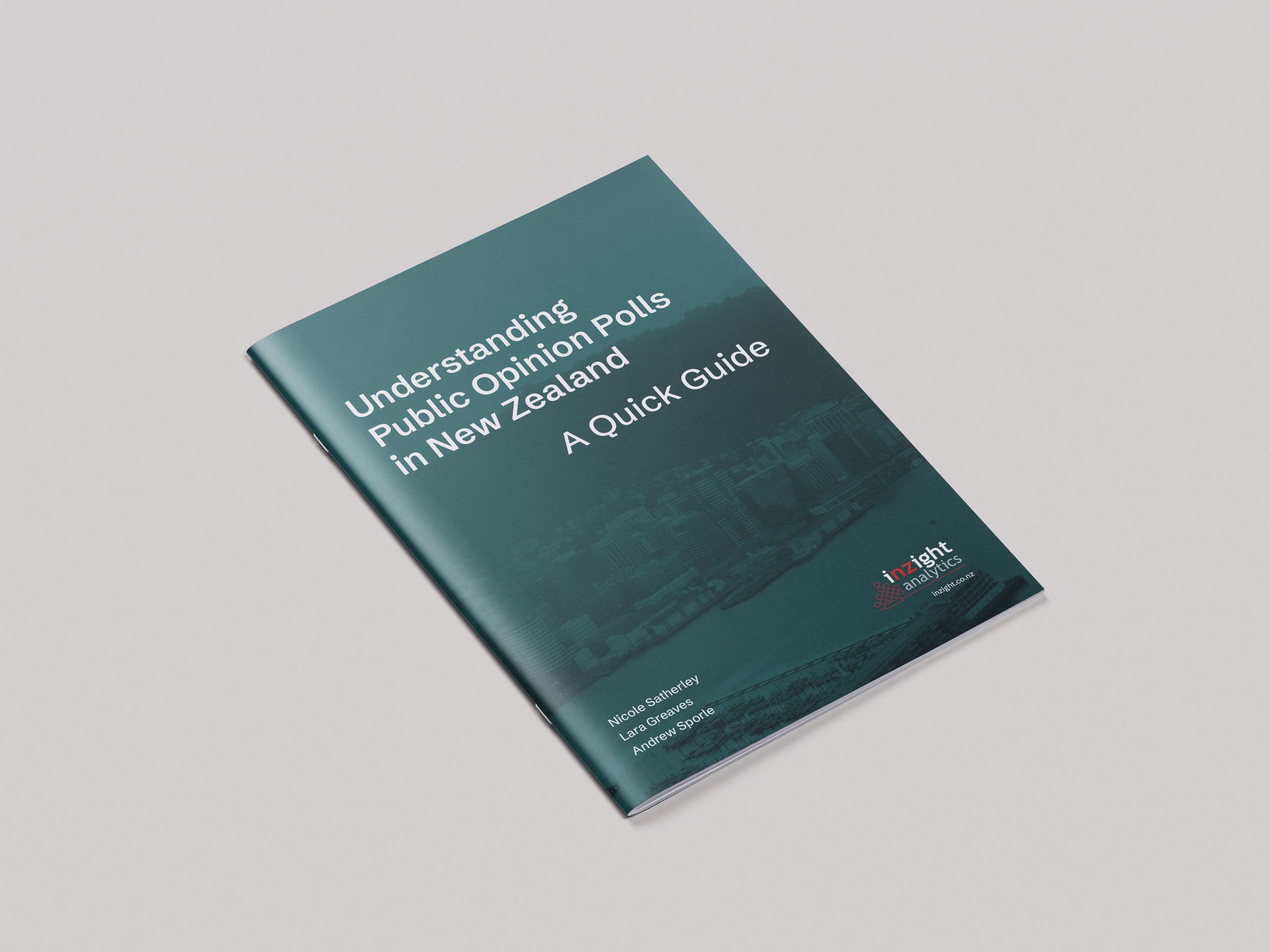
A quick guide to understanding political polling in New Zealand, this booklet outlines how polls work, aspects of polls that speak to their quality, including sample size, error, and sampling methods, and how polls relate to actual party representation in parliament.
Funded by: iNZight Analytics
Public opinion polling is an important tool for understanding how a population feels about a particular issue, or which political parties they would vote for. But which details about a poll matter, and why?
This guide offers a brief overview of what information to look out for about a poll, and why this information should be transparent. It outlines how polls work, aspects of polls that speak to their quality, including sample size, error, and sampling methods, and how polls relate to actual party representation in parliament. Journalists reporting on a poll should report information on each of these features as they give important information to evaluate the reliability of the poll results.
If you’d like more information about each of these points, and political polling in the New Zealand context, please consult the accompanying detailed guide, accessible here .

There is an expressed need of Māori providers and communities for high quality, localised information that can be used to inform and monitor interventions to improve key Maori health outcome measures. Te Hao Nui is a longitudinal study that will link together the data from Te Kupenga, the Integrated Data Infrastructure (IDI), and the Longitudinal Census Database to create the world’s largest and most comprehensive indigenous longitudinal study capable of following individual pathways forwards and backward in time.
Funded by: Health Research Council
Grant number: 18/849
The study entirely draws on previously collected administrative data, no new data are collected as part of this project.
Focusing on informing local interventions and policy, this project will transform national statistics into locally accessible information linked into service delivery planning and evaluation at the iwi, rohe as well as at the regional level.
Linking into existing iwi and regional Māori development plans, this project will produce information that will immediately inform the delivery of services and interventions to improve rangatahi wellbeing.
It will additionally create a permanent resource within the official statistics system that can be used for research, evaluation, and monitoring of rangatahi well-being on an on‐going basis.

iNZight is heavily involved with the Te Ao Mārama: Māori Health, Wellbeing & Social Survey Panel. Tom Elliott, Lara Greaves, and Andrew Sporle are current members of the Te Ao Mārama team, which works on a variety of projects primarily in the disability space.
Hosted by: Te Ao Mārama Aotearoa Trust
From Te Ao Mārama: Te Ao Mārama is a Māori-led, Māori-governed national research infrastructure designed to strengthen Māori knowledge, wellbeing, and equity. Our kaupapa is guided by Te Tiriti o Waitangi, kaupapa Māori research values, and tāngata whaikaha Māori data sovereignty. The documents below set out our principles, processes, and ethical framework for how the Panel operates, protects participants, and upholds Māori aspirations.
The iNZight team have contributed to a number of papers with Te Ao Mārama, listed below.

Despite evidence that Māori experience disproportionate rates of disability, there is a lack of accurate, culturally-grounded data on the prevalence and impacts of disability on Māori. This limits understanding of how disability affects Māori health, wellbeing, social inclusion, and economic outcomes, and constrains efforts to address these inequities in policy and disability services.
Funded by: Health Research Council of New Zealand
Hosted by: University of Otago
Led by Bernadette Jones, this project used a Māori-led methodological approach to develop culturally appropriate measures of disability, quantify its prevalence, and examine its impacts on health, wellbeing, social participation, and economic outcomes. It involved a large-scale quantitative survey designed to better understand lived experiences of disability by Māori. The survey explored cultural identity alongside everyday experiences of disability, including the language people use to describe themselves and their limitations.